How the game works
Rules & strategy
2,222 seekers charge toward 9,000. Moving one gives a quarter of its charge to all the others. That's the whole game: every move makes everyone else stronger.
The short version
- Every seeker fills up by 50 a day. At 9,000 it wakes up.
- Selling or sending a seeker costs it a quarter of its charge. That quarter is handed out evenly to every other seeker.
- So holding pays twice: your own 50 a day, plus a cut of everyone else's moves.
- Discharge is what your seeker gave away the last time it moved. Uplink is everything it has ever given away.
- Two games, straight from the 2017 Snek. The main quest is charge: hold and reach 9,000. The side quest is Discharge and Uplink: move, power the network, and build the numbers the art will reflect.
- How a seeker activates decides what it gets. The art keeps getting new traits for the path each seeker took, so there's no single best path. The rares will be the paths fewer people take.
- Not sure? The team's own advice: buy and hold.
The details and the math are below, then some guesses about where this goes.
The rules
| Charging | Every seeker under 9,000 gains +50 a day. With all 2,222 dormant, that's 111,100 new charge across the network every day. |
| A move | Any transfer (a sale, a gift, a move between your own wallets) releases 25% of the seeker's charge. It keeps 75%. |
| The split | The 25% is split equally among every other seeker that isn't recorded yet (2,221 today), whatever their charge. The mover gets no part of its own release. |
| Discharge | Metadata trait: the size of the seeker's latest release. A new move replaces it. |
| Uplink | Metadata trait: all the charge the seeker has ever released, cumulative. Each move adds that move's release plus the share of it the seeker didn't get back. Never moved: 0. |
| 9,000 | The seeker activates and stops growing until it's recorded. Its first touch (its next move, or anyone calling activate()) records it at exactly 9,000, tax-free. Charge above 9,000 before that is lost. |
| Recorded | Grows +50 a day above 9,000 and leaves the dormant pool. A move then releases 25% of only the charge above 9,000, shared among the other recorded seekers. |
One identity explains everything
For every seeker under 9,000:
charge + Uplink = starting charge + 50 a day + the dormant pool
The right side is the same for every seeker except its starting roll: they all get the same 50 a day and the same pool. So charge and Uplink are one quantity counted from two sides: what the seeker kept, and what it sent out to power everyone else. One seeker can't max both. You pick its role.
Two roles, straight from PoWH
The Dividend Snek of 2017 had two kinds of players, and the game needed both. Holders sat still and collected a cut of every trade. The people who made the trades, and the masternodes who brought them in, were the engine: without volume there were no dividends. PoWH paid its masternodes for it.
SEEKER NET keeps both roles. Charge is the holder's number: what the seeker kept plus everything the network paid it. Uplink is the engine's number: every point of charge the seeker has sent out to the other 2,221, written into its metadata for good. A seeker with a big Uplink is one that powered the network.
| Holder | Uplinker | |
|---|---|---|
| In PoWH | Strong hands, collecting dividends | The volume and the masternodes that made the dividends |
| Does | Never moves | Moves, trades, sends |
| Grows | Charge: +50 a day plus the pool | Uplink: +25% of its charge on every move |
| Wins | The race to 9,000 | The record of who fed the Snek |
The network right now
- Days since the reveal
- …
- Moves
- …
- Charge released by moves
- …
- Dormant pool (each seeker)
- …
- Pool pace
- … vs +50 a day charging
- Dormant seekers
- …
- New charge, network
- …
What one move does
A seeker with charge c that moves:
- keeps 0.75 × c and releases 0.25 × c (its new Discharge),
- adds about 0.25 × c to its Uplink (exactly 0.25 × c × 2,222 / 2,221),
- gives every other dormant seeker 0.25 × c / 2,221, about c / 8,884,
- loses c / 200 days of charging: a move at 4,000 costs 20 days, at 8,000 it costs 40.
Moving again repeats it on what's left, so charge falls to 0.75, 0.56, 0.42… of where it was, and Uplink climbs toward everything the seeker had. A seeker at 8,500 moved back to back:
| Moves | Charge left | Uplink | Each other seeker | Days of charging given up |
|---|---|---|---|---|
| 1 | 6,375 | 2,126 | +0.96 | 42 |
| 2 | 4,781 | 3,720 | +1.67 | 74 |
| 3 | 3,586 | 4,916 | +2.21 | 98 |
| 5 | 2,017 | 6,486 | +2.92 | 130 |
| 10 | 479 | 8,025 | +3.61 | 160 |
Try a seeker
Loading live charge…
What the team has said
- Two games. "Charge is one game, discharge is another. Pick your strategy." (@TheSeekerGame, 12 Oct)
- Main quest and side quest. How you activate determines what you get: go straight for charge, or grind Discharge, Uplink "and more to come" first. They've shown a sneak peek of high-Uplink activations. (@TheSeekerGame)
- Buyers get the Discharge. A sale's 25% goes to holders, and the seeker keeps that last release as its Discharge, so a buyer always gets it as a bonus. Discharge will have its own use. (@TheSeekerGame, 13 Oct)
- The art keeps growing. No new NFTs: the seekers' traits keep getting upgraded by top pixel artists until every decision in the game shows up as a trait, community participation included. The final art of each seeker is a record of its journey. (the dev, c12, on Discord)
- For rares, loadout is the safer play. Discharge can nudge OpenSea rarity a little, but the loadout is what makes a seeker rare. (c12, on Discord)
- If in doubt, buy and hold. That's the team's default for anyone who doesn't want to study the mechanics. (c12, on Discord)
Main quest: charge
- Don't move. A seeker that never moves keeps every point of its 50 a day and collects every share from every move by anyone.
- Count shares, not just days. Days to 9,000 = (9,000 − charge) ÷ (50 + pool pace). While the pool pays more than 50 a day, a holder charges more than twice as fast as the base rate.
- Record it at 9,000. An activated seeker stops growing until it's recorded. activate() costs only gas and anyone can call it; or the next move records it tax-free.
- Low rolls gain the most. Shares are equal, not proportional, so a Bare seeker at 100 gets the same +0.45 from a 4,000 move as a Standard at 8,000.
- Buying. The sale itself is a move, so a dormant seeker arrives with 75% of its listed charge, and with that sale's Discharge on it as a bonus. An activated seeker that isn't recorded yet moves tax-free: it arrives at exactly 9,000.
Side quest: Discharge and Uplink
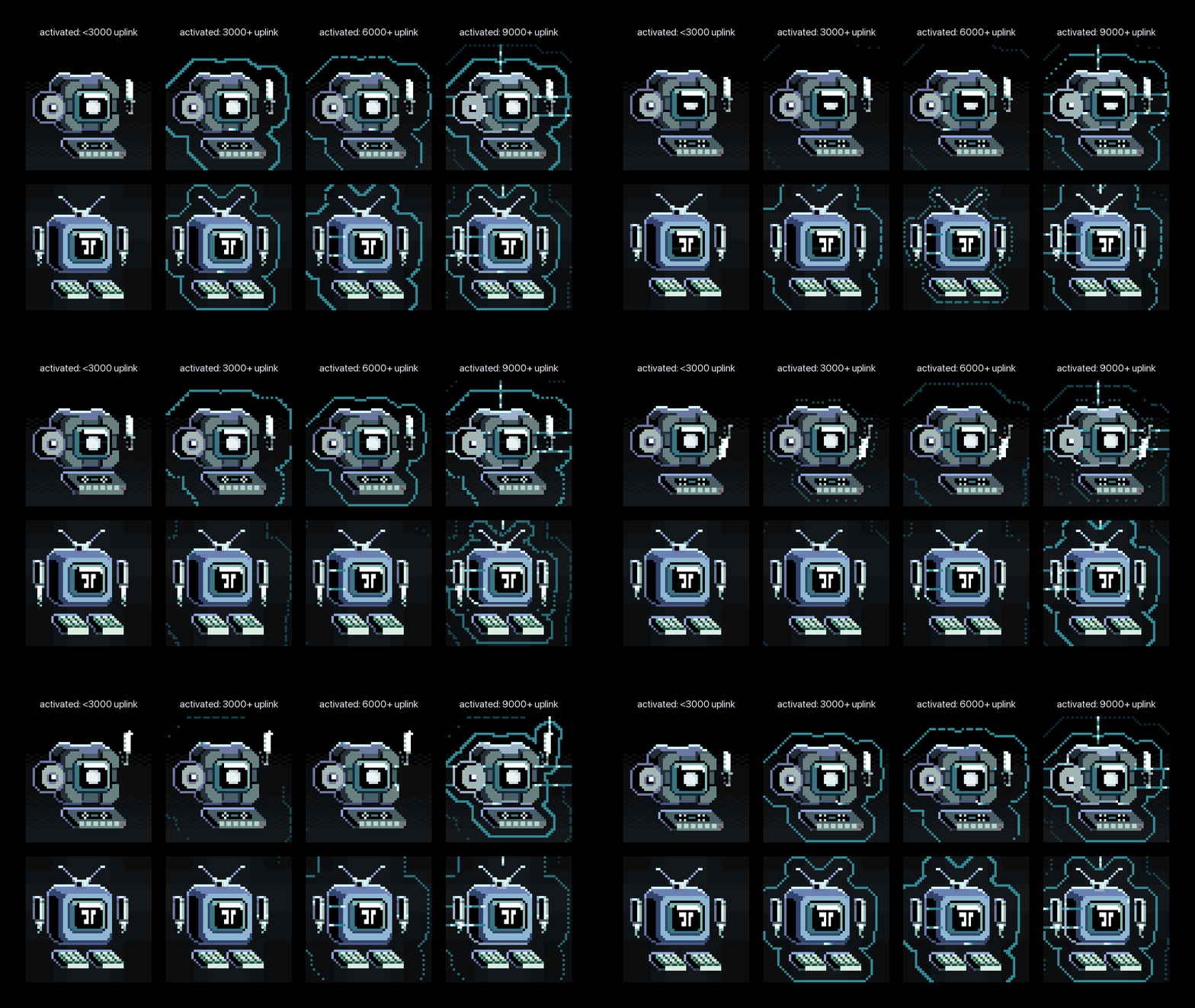
The art at activation shows the seeker's Uplink in four tiers, each with more of the network drawn around it. For a seeker that hasn't activated yet, Uplink is simple: everything it has earned (starting charge + 50 a day + the pool) minus the charge it holds. It activates at 9,000 charge, so its Uplink at that point is everything it earned beyond 9,000:
| Uplink tier | Total earned at activation |
|---|---|
| Under 3,000 | under 12,000 |
| 3,000+ | 12,000+ |
| 6,000+ | 15,000+ |
| 9,000+ | 18,000+ |
So the tier is really about time: every move pushes activation back, and every extra day before activating adds 50 plus the pool to the total. A seeker that holds still activates as soon as its total reaches 9,000 plus whatever Uplink it already has. To reach a higher tier, keep moving until the total gets there. The calculator above shows any seeker's Uplink now.
- Do it before 9,000. The side quest happens on the way to activation, and the art reflects how the seeker got there. Every point of charge it sends out pushes activation back, by that charge ÷ (50 + pool pace) days.
- Discharge rewards one big move. Discharge is only the latest release, so a second move right after the first records 75% of it and replaces the bigger one. To beat your last Discharge, let the charge climb back above where it was before moving again. That's why the community advice is: one move is nice, extra moves can hurt your stats.
- Uplink only grows by giving charge away. Its ceiling is everything the seeker ever had: starting charge + 50 a day + its pool.
- Move at the highest charge, under 9,000. One move at 8,500 adds 2,126; the same move at 2,000 adds 500. Waiting to move costs nothing: charge keeps accruing either way.
- Don't cross 9,000 first. Past 9,000 the first move is tax-free, so it adds no Uplink, and later moves only release charge above 9,000.
- Repeat moves have diminishing returns. Three moves at 8,500 reach 4,916 Uplink; ten reach 8,025 and leave 479 charge.
- Uplink rewards many moves. It's the running total, the PoWH masternode stat: how much a seeker has powered the network. It only goes up, it's in the metadata, and the team has teased high-Uplink activation art.
- The paths less traveled. Rarity will come from the path a seeker took. If everyone holds, the side quest paths are the rare ones; if everyone grinds Uplink, a pure holder is. Watch what the crowd does.
How every move lifts everyone else
A move creates no charge and destroys none: it moves a quarter of one seeker's charge into the pool, and the pool is everyone else's. So the network's total only grows through the 50 a day. Moves decide who holds it.
- Each move of a seeker at c adds c / 8,884 to every other dormant seeker. A day with 200 moves at an average 4,000 adds about +90 to every holder, almost two days of charging.
- Moving one seeker to feed your others barely works: with 10 seekers you get back 10 / 2,221, under half a percent, of what you release.
- Recorded seekers leave the dormant pool, so as more pass 9,000 the same move pays the rest more each.
- Activated seekers that aren't recorded still count in the split but can't keep their share, so part of every release is wasted until someone calls activate().
Scenarios: where this could go
Speculation, not prediction. Numbers use the live charges at publishing time: median seeker at 4,349, lowest 241, highest 8,855, and a pool that has paid +86 a day so far. That pace includes the reveal-day rush, so it may well slow.
| If the pool pays | Median seeker hits 9,000 | 90% of seekers | The last one |
|---|---|---|---|
| Nothing (nobody moves) | ~93 days | ~158 days | ~175 days |
| +50 a day | ~47 days | ~79 days | ~88 days |
| +86 a day (so far) | ~34 days | ~58 days | ~64 days |
| +300 a day (frenzy) | ~13 days | ~23 days | ~25 days |
Days from now, for seekers that never move. A +300 day takes about 670 moves of seekers around 4,000.
- Everyone holds. The pool stops growing and it's a pure clock: +50 a day for everyone, and the starting roll decides the order. The most boring outcome is also the slowest one.
- Trading keeps going. Every sale pays the holders. The more the market churns, the sooner the holders wake up, and the traders pay for it with their seekers' charge. Holders do best when other people trade.
- An Uplink race. If Uplink becomes the number people show off, some will move the same seeker again and again. Ten back-to-back moves at 8,500 build 8,025 Uplink, leave 479 charge, and hand every other seeker +3.6. An Uplink race is the Snek at full speed: the racers top the leaderboard and every holder charges faster because of them.
- The first wave hits 9,000. The top seekers are only days away. Each one that's recorded leaves the dormant split, so every later move is shared among fewer seekers and pays each a little more. Until someone calls activate() on it, an activated seeker still takes a share it can't keep, so recording promptly helps everyone still charging.
- Trading moves past 9,000. A recorded seeker only pays 25% of its charge above 9,000, and its first move after activating is free. Recorded seekers are cheap to move, so trading may shift there, and the dormant pool's growth would slow as it does.
- The endgame. The last seekers charging are the low rolls: mostly Bare, Fully Loaded and Light, the rarest art. With few dormant seekers left, every dormant move is split among a handful of them. If anyone is still moving, the rarest builds could finish surprisingly fast.
- New traits land. The team plans to keep adding art for every decision in the game, so each path gets its own look. Seekers that took an unusual route (a big single Discharge, a huge Uplink, a low roll that held to the end) are the likeliest to end up one of a kind.
Rules are read from the SEEKER NET contract. Discharge and Uplink are as the current renderer reports them; Uplink for seekers past 9,000 isn't measured yet, since none have got there. Live numbers come from the monitor's snapshot, refreshed every minute.